
Roofing is consistently classified among the highest-risk specialty trades in the construction industry. Operating a roofing company in Massachusetts requires managing extreme height hazards, severe weather vulnerabilities, and strict state regulatory enforcement. From seasonal Nor'easters causing urgent tear-off work to high-pitched residential re-roofing across Greater Boston, your daily exposure to property damage and bodily injury claims is substantial.
At Kovalev Insurance, we specialize in high-risk commercial lines for Massachusetts trade contractors. We partner with top-rated insurance carriers to structure comprehensive roofing insurance packages that satisfy local building inspectors, comply with state licensing laws, and protect your company's balance sheet.
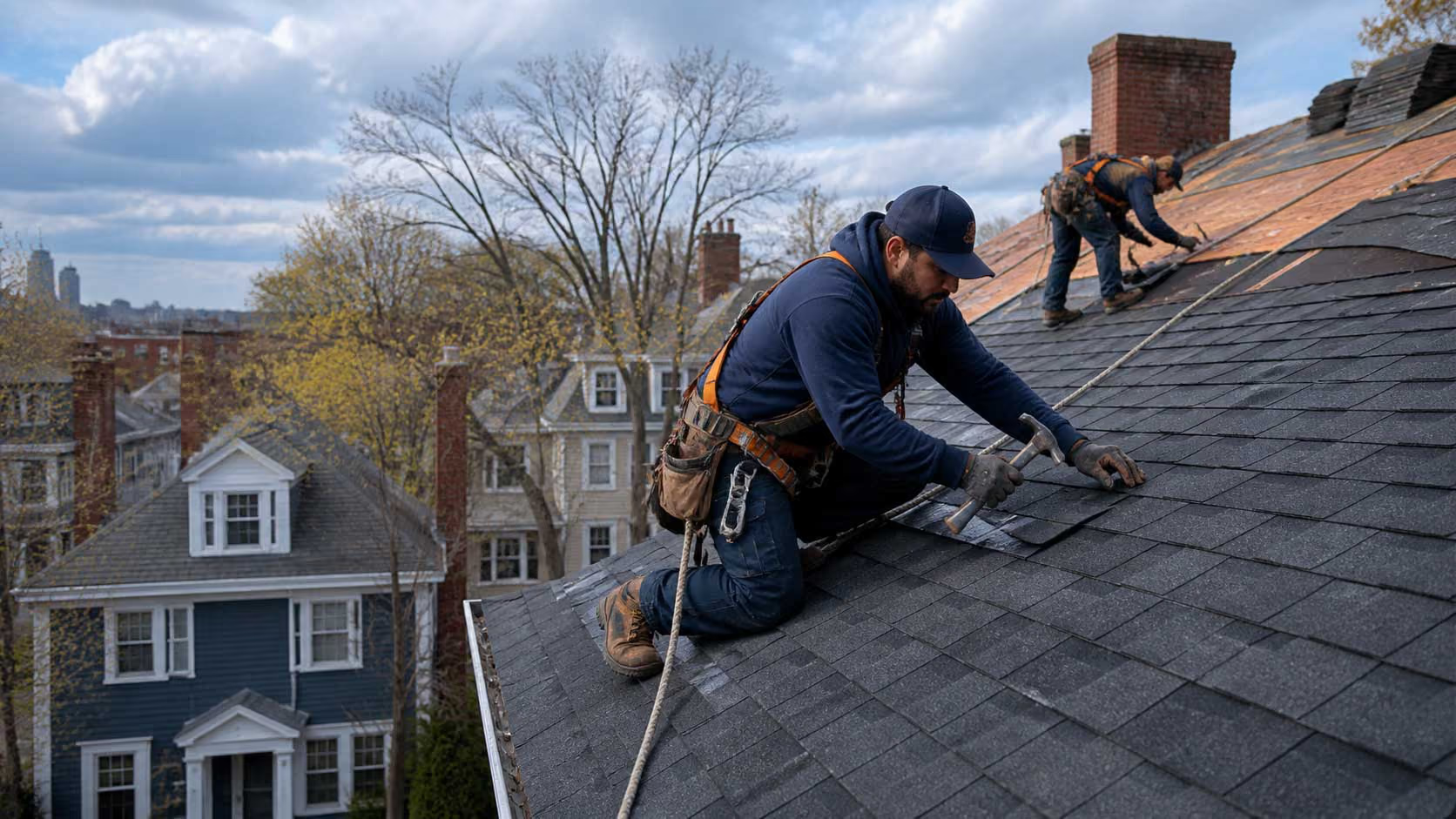
Roofing insurance in Massachusetts is a specialized commercial insurance policy designed to protect roofing contractors from high-risk bodily injury, severe property damage, and height-related liabilities. A standard roofing policy bundles General Liability—often featuring specific Open Roof Endorsements and Subcontractor coverage—with Workers' Compensation, Commercial Auto, and Inland Marine tool protection. Massachusetts state law mandates Workers' Comp for all roofing employees, while local building departments require proof of coverage to pull roofing permits.
To pull roofing permits in Massachusetts municipalities, contractors must navigate two separate licensing systems administered by the Commonwealth:
Municipal Permit Issuance: Under 780 CMR (Massachusetts State Building Code), local building inspectors in towns like Worcester, Newton, Springfield, and Boston will not issue a building permit without a current Certificate of Insurance listing the town as an Additional Insured or Certificate Holder.
Standard commercial general liability insurance policies often carry broad exclusions for roofing activities. Building an effective defense against catastrophic loss requires tailored coverages specifically underwritten for roof replacement, repair, and installation.
General Liability (GL) forms the backbone of your protection, covering third-party bodily injury and property damage. However, standard GL policies frequently contain an Open Roof Exclusion, which denies claims if water damages a structure while the roof framing or decking is exposed to the elements.
The Kovalev Solution: We explicitly structure your policy with an Open Roof Endorsement, ensuring that accidental rain damage during a active tear-off is fully covered under your completed operations and liability limits.
Massachusetts enforces strict Workers' Compensation compliance under M.G.L. Chapter 152. Because roofing involves significant height hazards, falling risks, and ladder usage, Massachusetts roofers are rated under NCCI Class Code 5551 (Roofing - All Kinds & Drivers).
Mandatory Pre-Hire Requirement: In Massachusetts, you must have an active Workers' Comp policy in place before a new employee works their first hour—there is no grace period.
Independent Contractor Scrutiny: Under the Massachusetts Independent Contractor Statute (M.G.L. c. 149 § 148B), the state applies a rigid ABC Test. Uninsured 1099 roofers working under your supervision are legally presumed to be your employees, leaving you exposed to severe audit adjustments, back-premiums, and state stop-work orders.
Your shingles and membrane materials may be on the roof, but your capital is tied up in ladders, staging, scaffolding, safety harnesses, air compressors, and tear-off chutes.
Inland Marine (Contractor's Equipment Floater): Standard commercial property insurance rarely covers mobile equipment off-premises. Inland marine coverage protects your valuable tools and staging gear whether they are stored in your yard, hauled in transit, or left at an active job site overnight.
If you subcontract specialized work (such as copper gutter fabrication, solar panel integration, or masonry chimney restoration), your primary policy could be compromised if those sub-trades carry insufficient coverage. We implement robust subcontractor liability endorsements and track your sub-contractors' Certificates of Insurance (COIs) to prevent claims from bouncing back to your policy.
Torch-Down & Open Flame Exclusions: Modified bitumen torch-applied roofing carries extreme fire risk. Standard residential shingle policies explicitly exclude open-flame application. If your crew performs commercial flat-roofing using hot-work, your policy must carry an explicit Torch-Down / Hot-Mop Endorsement.
Height & Pitch Limitations: Some low-cost insurance policies restrict coverage to structures under 3 stories or roofs with maximum pitch slopes (e.g., 6:12 pitch). If your crew works on historic multi-story homes or steep-church steeples, operating above your policy's height limitation voids your coverage.
Designated Work Exclusions: Ensure your policy does not carry blanket exclusions for commercial flat roofs, industrial membrane systems (EPDM/TPO), or slate/tile restoration if your crew undertakes multi-faceted jobs.
Roofing insurance premiums are calculated based on gross payroll, annual sales, trade classification (residential vs. commercial), height exposure, and claims history. Below is an estimated baseline of market rates for Massachusetts roofing contractors:
| Business Structure & Trade Focus | Primary Coverages Included | Est. Monthly Premium | Est. Annual Premium |
|---|---|---|---|
| Business Structure & Trade FocusResidential Shingle Sole Proprietor (No Employees, Under $150k Revenue) | Primary Coverages IncludedGeneral Liability ($1M/$2M) + Basic Tools & Equipment | Est. Monthly Premium$175 – $350 | Est. Annual Premium$2,100 – $4,200 |
| Business Structure & Trade FocusResidential Roofing Crew (2–4 Employees, Class Code 5551 Payroll) | Primary Coverages IncludedGeneral Liability + Open Roof + Mandatory Workers' Comp | Est. Monthly Premium$750 – $1,600 | Est. Annual Premium$9,000 – $19,200 |
| Business Structure & Trade FocusCommercial & Flat-Roof Specialist (Torch-Down, High Revenue, 5+ Employees) | Primary Coverages IncludedGeneral Liability + Hot-Work Endorsement + Workers' Comp + Inland Marine | Est. Monthly Premium$2,200 – $4,500+ | Est. Annual Premium$26,400 – $54,000+ |
In the roofing industry, delayed paperwork means delayed projects. Whether you are bidding on a commercial property management contract or pulling an emergency repair permit after a windstorm, you cannot start work without a verified Certificate of Insurance (COI).
At Kovalev Insurance, we provide rapid-response COI generation. We issue customized certificates detailing your General Liability, Workers' Comp, and Additional Insured status directly to city permit offices and general contractors within minutes, keeping your schedule on track.
Do I need proof of roofing insurance to pull a building permit in Massachusetts?
Yes. Local building departments operating under the Massachusetts State Building Code (780 CMR) require roofing contractors to present a valid Certificate of Insurance (COI) before issuing a building permit. You must provide proof of General Liability coverage, along with Workers' Compensation if you employ workers or use 1099 labor. Municipalities routinely require the city or town to be listed as a Certificate Holder or Additional Insured.
What is an Open Roof Endorsement, and why is it essential for MA roofers?
An Open Roof Endorsement modifies standard commercial general liability policies to explicitly cover property damage caused by weather—such as sudden rain or snow during a tear-off—while structural framing or decking is exposed. Standard contractor liability policies frequently carry open-roof exclusions that deny claims for water damage during active roof replacements. Securing this endorsement is crucial for surviving volatile Massachusetts weather like sudden Nor'easters.
Are 1099 subcontractors covered under my Workers' Comp policy in Massachusetts?
Under the Massachusetts Independent Contractor Statute (M.G.L. c. 149 § 148B), the Commonwealth enforces a strict three-part "ABC Test" that presumes most workers are employees. If you hire 1099 subcontractors who perform roofing work within your normal course of business and they do not carry their own active Workers' Comp policy, state insurance audits will classify them as your employees under NCCI Class Code 5551. This can result in significant audit back-premiums and potential state stop-work orders.
What is the difference between HIC registration and CSL licensing for MA roofers?
Home Improvement Contractor (HIC) registration is required under M.G.L. c. 142A for residential roof repairs and replacements on existing 1-to-4 family owner-occupied homes exceeding $1,000. A Construction Supervisor License (CSL) under 780 CMR is required if the project involves structural work (such as replacing rafters, trusses, or load-bearing sheathing) or commercial building systems. Both credentials require proof of active commercial liability insurance to satisfy state and municipal oversight.
Does a standard MA roofing policy cover torch-down or open-flame commercial work?
No. Standard general liability policies usually contain strict torch-down, hot-mop, or open-flame exclusions. If your crew applies modified bitumen or flat-roof membrane systems using heat torches, you must secure a specific Hot Work / Torch-Down Endorsement. Operating without this endorsement means any fire damage or bodily injury claim resulting from open-flame operations will be completely denied by the carrier.
Don't let rigid policy exclusions, strict state audits, or permit delays jeopardize your roofing business. Partner with an independent agent who understands the unique risks of Massachusetts construction.

X