Mass Appeal: Your Guide to MA Home Insurance Policies

3

Sep

2026

massachusetts coastline with ome - homeowners insurance policies Massachusetts MA concept

Author:

Michael Kovalev

Why Homeowners Insurance Policies in Massachusetts Deserve a Closer Look

Homeowners insurance policies in Massachusetts sit at the crossroads of nor'easters, coastal flooding risk, aging housing stock, and some of the highest home values in the country — making the right coverage more important here than in most other states.

Here's a quick snapshot of what Massachusetts homeowners need to know:

Topic Key Fact
Required by law? No, but mortgage lenders almost always require it
Average annual cost $1,275–$1,545/year (19–27% below the national average)
Standard coverage includes Dwelling, personal property, liability, loss of use, medical payments
Common gaps Flood damage, water backup, sewer overflow — all excluded by default
Last-resort option Massachusetts FAIR Plan (MPIUA) for hard-to-insure properties
Biggest local risks Winter storms, ice dams, coastal wind, kitchen fires

Despite below-average premiums, Massachusetts is not a low-risk state. Premiums jumped nearly 15% between 2022 and 2023, and only about 2% of Massachusetts homes carry flood insurance — even in areas with real exposure. Coastal communities, older homes in cities like Newton and Wellesley, and properties near waterways all face risks that a standard policy may not fully cover.

This guide breaks down exactly what you're covered for, what you're not, and how to compare policies so you're not caught off guard when you need to file a claim.


‍

Infographic showing key facts about Massachusetts homeowners insurance policies including average cost, standard coverages

Understanding Homeowners Insurance Policies Massachusetts MA

‍

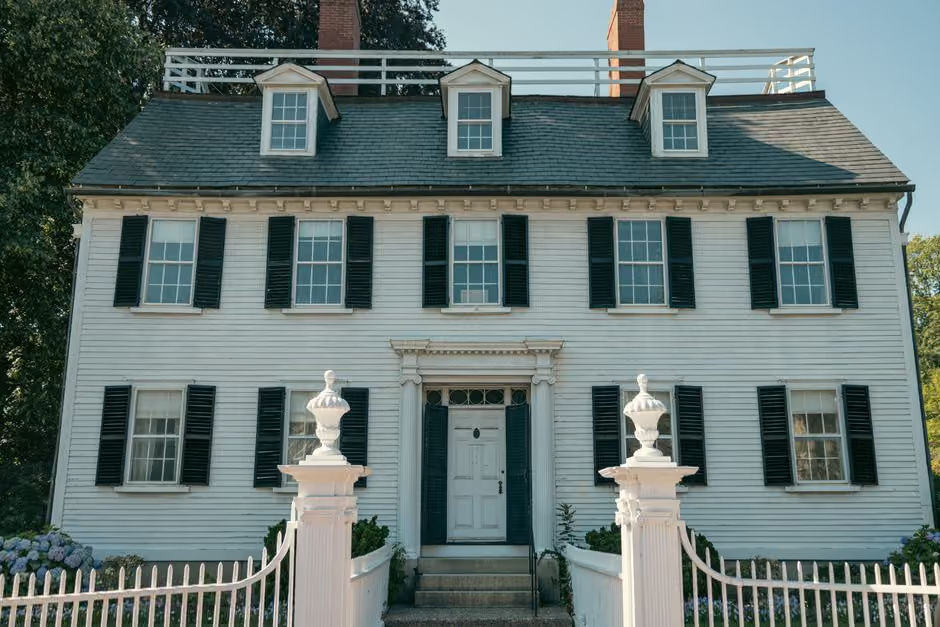
A historic Massachusetts home in Brookline showing classic New England architecture

Every home insurance policy is a legal contract. While it might look like a mountain of confusing legalese, a standard policy is actually quite structured. Understanding this structure is the first step to ensuring you are not underinsured.

When you receive your policy packet, it will be broken down into several key components:

  • The Declarations Page: This is your policy's cover sheet. It lists your name, address, policy number, coverage limits for each category, your deductible, and your annual premium.
  • Definitions: This section defines key terms (like "insured" or "occurrence") to prevent ambiguity during a claim.
  • Coverage Sections: This outlines exactly what is insured, from the physical structure of your home to your personal belongings.
  • Exclusions: This is arguably the most important section, as it details what the policy will not pay for (such as floods or earthquakes).
  • Conditions: These are the rules you and the insurance company must follow, such as how quickly you must report a loss.
  • Endorsements: These are customized add-ons or riders that modify your policy, such as adding extra coverage for jewelry or water backup.

Is Home Insurance Required in Massachusetts?

Technically, no state law in the Commonwealth of Massachusetts mandates that you purchase homeowners insurance. If you own your home outright with no outstanding debt, you could legally go without it (though we would strongly advise against this unless you have a few hundred thousand dollars burning a hole in your pocket).

However, if you have a mortgage — which most of us do — your lender will absolutely require you to maintain active coverage. To a bank, your home is a major financial asset securing their loan. If a fire or severe winter storm destroys the property, the lender wants to ensure their investment is protected.

If you let your policy lapse, your lender has the right to purchase "force-placed insurance." This is typically much more expensive than a policy you would find on your own and offers far less protection. To learn more about how these requirements work in the Bay State, take a look at our detailed breakdown on Home Insurance Required in Mass and read the official guidelines on Is Homeowners Insurance Mandatory in Massachusetts. You can also review the state's consumer overview on Understanding Home Insurance | Mass.gov .

Standard Coverage in Homeowners Insurance Policies Massachusetts MA

When you purchase standard homeowners insurance policies in Massachusetts (typically written on an HO-3 policy form), you are getting a package of six core coverages:

  1. Dwelling (Coverage A): This covers the physical structure of your home, including the walls, roof, and attached structures like a garage or deck.
  2. Other Structures (Coverage B): This protects standalone structures on your property, such as a detached shed, fence, or gazebo. It is usually capped at 10% of your dwelling coverage.
  3. Personal Property (Coverage C): This covers your personal belongings — furniture, clothes, electronics, and appliances — even if they are damaged or stolen outside of your home. It typically limits coverage to 50% of your dwelling limit.
  4. Loss of Use / Additional Living Expenses (Coverage D): If a covered disaster makes your home uninhabitable, this pays for temporary housing, restaurant meals, and other extra living costs while your home is being repaired.
  5. Personal Liability (Coverage E): This protects you if someone is injured on your property or if you accidentally cause property damage to someone else and face a lawsuit. Coverage usually starts at $100,000, though we recommend higher limits.
  6. Medical Payments (Coverage F): This pays for minor medical bills (typically up to $1,000 or $5,000) for guests injured on your property, regardless of who was at fault.

To explore these core protections further, read our guides on What Does MA Home Insurance Cover and the Home Insurance Complete Guide 2025. For official answers to common coverage scenarios, check out the Frequently Asked Questions about Homeowners Insurance | Mass.gov .

It is equally important to know what your standard policy leaves out. Standard policies in Massachusetts exclude several major perils:

  • Flooding (from rising coastal waters, heavy rain, or storm surges)
  • Earth movement and earthquakes
  • General wear and tear, neglect, or lack of maintenance
  • Sewer and drain backups (unless added via endorsement)
  • Power failures occurring off the residence premises
  • Damage from pests, mold, or wet rot

Optional Coverages for Bay State Homes

‍

Preventing water backup damage in a Massachusetts basement

Because Massachusetts experiences everything from coastal hurricanes to severe winter freezes, relying solely on a basic policy can leave you exposed. We highly recommend customizing your policy with targeted endorsements:

  • Water Backup and Sewer Overflow: If a heavy rainstorm causes your sump pump to fail or the local sewer line backs up into your basement, a standard policy won't pay for the cleanup. Adding a water backup endorsement is highly affordable and can save you tens of thousands of dollars in restoration costs.
  • Flood Insurance: Only about 2% of Massachusetts homes have flood insurance. Since standard policies exclude flood damage, we recommend purchasing a separate policy through the National Flood Insurance Program (NFIP) or private carriers, especially if you live near the coast or in low-lying areas of Needham or Belmont.
  • Extended Replacement Cost: Rebuilding costs in Greater Boston have skyrocketed due to labor shortages and material inflation. If a disaster strikes, an extended replacement cost endorsement can provide an extra 20% to 50% above your policy’s dwelling limit to ensure you can fully rebuild your home.
  • Inflation Guard: This automatically increases your dwelling coverage limit annually to keep pace with rising construction costs in your local community.
  • Scheduled Personal Property: Standard policies place strict sub-limits on high-value items (like $500 for jewelry theft or $100 for cash). Scheduling items like engagement rings, fine art, or family antiques ensures they are covered for their full appraised value without a deductible.

Costs, the FAIR Plan, and How to Compare Policies

The cost of your home insurance is calculated using a variety of risk factors. In Massachusetts, insurers look closely at:

  • The age of your home: Massachusetts has some of the oldest housing stock in the country. Homes older than 60 years can cost 70% to 100% more to insure due to outdated electrical systems, plumbing, and historic plasterwork.
  • Construction materials: Brick homes are generally cheaper to insure against fire than wood-framed homes.
  • Your credit score: In Massachusetts, a poor credit history can increase your home insurance premiums by 100% to 170%.
  • Your location: Properties closer to the coast or in areas with higher crime rates naturally face higher premiums.
  • Your deductible: Choosing a higher deductible (e.g., moving from $500 to $1,000 or $2,500) can reduce your annual premium by 13% to 23%.

Average Costs and Rates for Homeowners Insurance Policies Massachusetts MA

Fortunately, Massachusetts homeowners enjoy average premiums that are roughly 19% to 27% cheaper than the national average. Depending on the data source, the state average ranges between $1,275 and $1,545 per year (or about $106 to $128 per month).

However, average rates vary significantly depending on the replacement value of your home. To learn more about how these averages are calculated, read our resource on the Average Cost of Home Insurance Massachusetts and explore general pricing trends in our guide to Homeowners Insurance Cost.

Here is a general look at how average premiums scale with different home replacement values in Massachusetts:

Estimated Home Replacement Value Average Annual Premium in MA National Average Comparison
$300,000 $1,142 $1,636 (MA is 30% cheaper)
$400,000 $1,596 $2,179 (MA is 26% cheaper)
$600,000 $2,305 $3,032 (MA is 24% cheaper)

To keep your premiums as low as possible, always ask about available discounts:

  • Multi-Policy Bundling: Combining your home and auto insurance with the same carrier can save you up to 20% on both policies.
  • Protective Devices: Installing smoke detectors, deadbolts, ring cameras, or a centrally monitored security system can earn you solid discounts.
  • Claims-Free History: If you haven't filed a home insurance claim in the last three to five years, carriers will reward you with lower rates.
  • New/Renovated Home: If your home was recently built or has completely updated wiring, plumbing, and roofing, you may qualify for a renovated home discount.

The Massachusetts FAIR Plan (MPIUA) Explained

If your home is located in a high-risk coastal area (such as parts of the Cape and Islands or coastal communities in Greater Boston) or if you have a complex claims history, you might find that traditional insurance companies refuse to offer you a policy.

In this scenario, you can turn to the Massachusetts Property Insurance Underwriting Association (MPIUA), commonly known as the FAIR Plan. Established as a residual market, the FAIR Plan is legally required to offer basic property insurance to any homeowner who has been denied coverage in the voluntary market, up to a replacement cost of $1 million.

While the FAIR Plan is an excellent safety net, it should be treated as a last resort. Policies through the MPIUA often come with higher premiums, stricter wind deductibles (which can require you to pay up to 5% of your dwelling limit out-of-pocket for wind damage), and fewer coverage options than a standard policy. If you are struggling to find coverage, read our guide on finding the Best Homeowners Insurance Massachusetts to explore your options before turning to the FAIR Plan.

How to Shop and Compare Policies in Local Communities

When shopping for homeowners insurance policies in Massachusetts, the best approach is to work with an independent insurance agency rather than a single "captive" brand. Captive agents can only sell policies from one company. Independent agents, like us at Kovalev Insurance, work with multiple highly rated regional and national insurance carriers to compare coverages and rates on your behalf.

Whether you live in Newton, Wellesley, Brookline, Needham, Belmont, or Natick, local expertise matters. A local agent understands that a home in Brookline might need specialized historic restoration coverage, while a home in Natick might require specific water backup limits due to local high-water tables.

At Kovalev Insurance, we make shopping for coverage simple and stress-free. We help you balance cost and protection so you never have to worry about whether a claim will be paid.

Ready to protect your home? Get started today by requesting your Home Insurance Quotes Massachusetts. If you live closer to the city, check out our specialized guide to Homeowners Insurance Boston, and let us help you find the absolute Best Homeowners Insurance Massachusetts for your family.
Blog Content

Contact Massachusetts business and Personal insurance Agency