Get the Right Condo Insurance: A Step-by-Step Guide for Owners
6
Sep
2026
Author:
Michael Kovalev
Why Your Massachusetts Condo Needs Its Own Insurance
Insurance for condo owners protects what your building's master policy doesn't cover—your personal belongings, interior upgrades, and liability within your unit. If you think your condo association's insurance covers everything, think again. The master policy protects the building and common areas, but it leaves significant gaps that require a separate HO-6 policy.
Personal Property Coverage - Protects your furniture, electronics, and belongings
Interior Structure Coverage - Covers walls, floors, and fixtures inside your unit
Personal Liability Protection - Covers injuries to guests in your unit
Additional Living Expenses - Pays for temporary housing if your unit becomes uninhabitable
Loss Assessment Coverage - Helps pay your share of building-wide damage costs
Massachusetts condo owners in towns like Brookline, Wellesley, or Needham must understand their coverage to avoid unexpected losses. Your mortgage lender likely requires condo insurance, but more importantly, you need it to protect your financial investment. The cost of condo insurance in Massachusetts is significantly less than homeowners insurance because you aren't insuring the entire building. I'm Mikhail Kovalev of Kovalev Insurance Agency, and my team has helped hundreds of Massachusetts condo owners secure the right policy for their financial security and peace of mind.
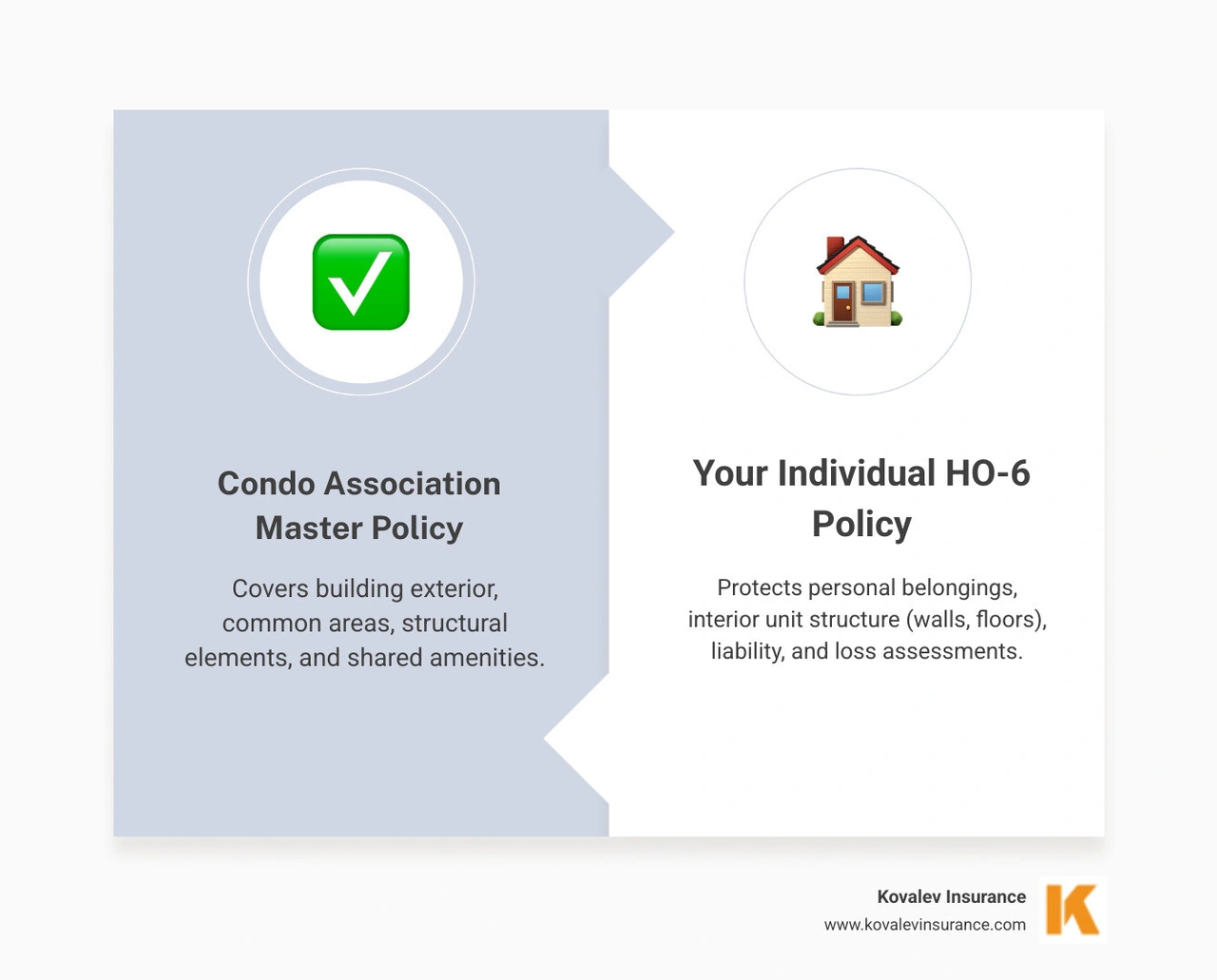
The infographic above illustrates the division of responsibility between the master policy and your individual HO-6 policy. Understanding this split is key to getting comprehensive protection.
Condo insurance (an HO-6 policy) is designed for individual unit owners. It complements the master policy held by your condo association. Here’s what an HO-6 policy typically covers:
Personal Property Protection: This covers your belongings—furniture, clothing, electronics, and appliances—if they are damaged or stolen. High-value items like jewelry may require additional coverage, known as a "floater" or endorsement.
Interior Structure (Dwelling) Coverage: The master policy covers the building's exterior, while your HO-6 policy covers the "walls-in." This includes drywall, flooring, cabinets, fixtures, and any improvements you've made, like a renovated kitchen in your Wellesley condo.
Liability for Guests: This protects you from financial responsibility if a guest is injured in your Belmont condo or if you cause damage to another person's property. It can cover medical bills and legal defense costs.
Additional Living Expenses (ALE): If a covered loss makes your condo uninhabitable, ALE (or "loss of use") covers the increased costs of living elsewhere temporarily, such as hotel stays and restaurant meals.
How condo insurance differs from homeowners insurance
Insurance for condo owners and homeowners insurance differ due to the unique ownership structure of condominiums.
Here’s a quick comparison:
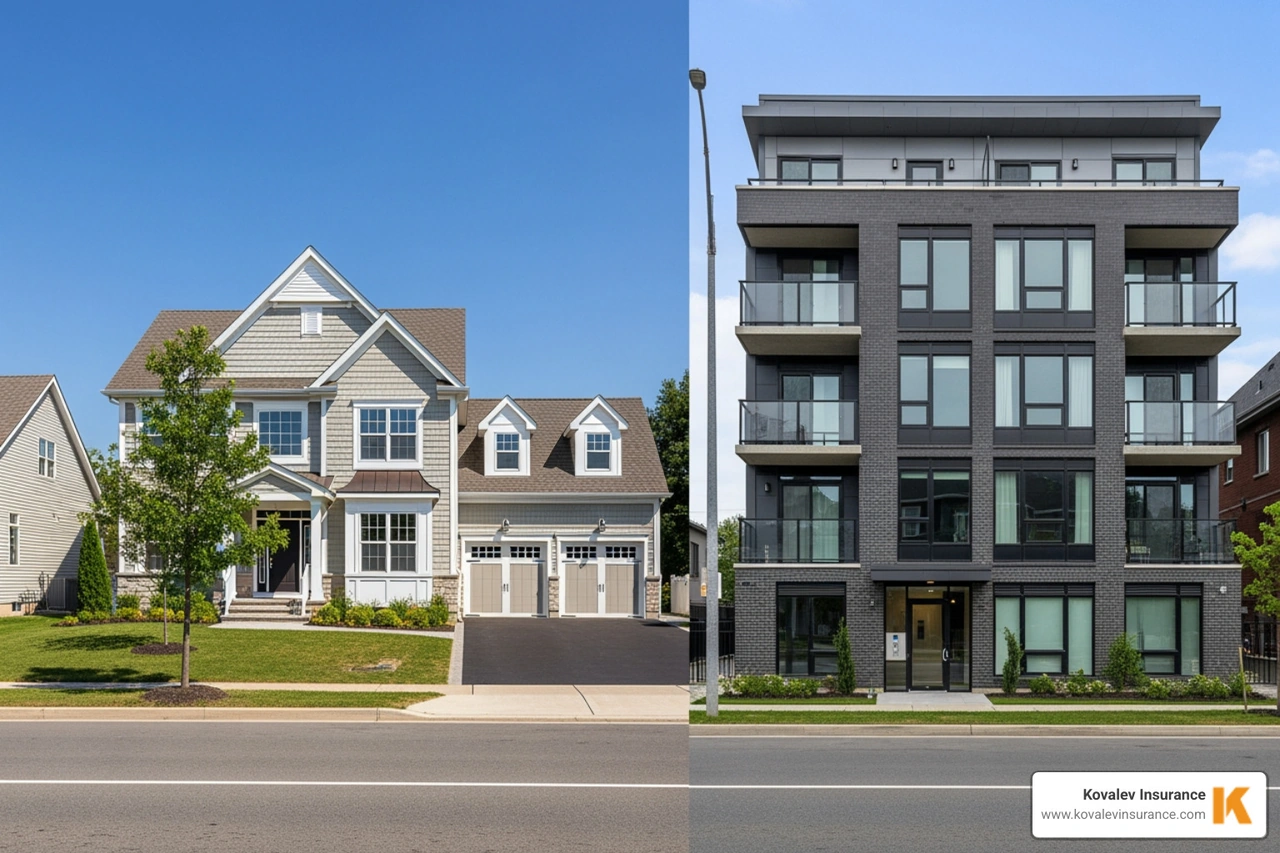
Dwelling Coverage Scope: A homeowners policy (HO-3) covers the entire home structure. A condo policy (HO-6) covers only the interior of your unit, as the master policy insures the building exterior and common areas.
Shared Structures and Common Areas: In a condo, you share ownership of lobbies, gyms, and hallways. The association's master policy insures these shared elements. A homeowner is solely responsible for all structures on their property.
Cost Differences: Because condo owners insure less property, insurance for condo owners is significantly less expensive than homeowners insurance. In Massachusetts, condo insurance is a much more affordable option than insuring a standalone house.
To determine your coverage needs, you must understand your condo association's master policy. The association's bylaws and master deed specify which of the three common policy types they carry, which dictates where their responsibility ends and yours begins.
"Bare Walls-In" Coverage: This is the most limited master policy, covering only the building's structure and common areas. The unit owner is responsible for everything from the drywall inward, including flooring, cabinets, and fixtures. This requires you to have more extensive dwelling coverage on your HO-6 policy.
"Single-Entity" Coverage: This policy covers the building, common areas, and the original fixtures within your unit as installed by the builder. It does not cover any improvements or upgrades you've made, such as new hardwood floors in your Brookline condo. Your HO-6 policy must cover these upgrades.
"All-In" Coverage: This is the most comprehensive master policy, covering the building, common areas, and all fixtures and improvements within your unit. Even with this policy, you still need an HO-6 policy for your personal property, liability, and loss assessment.
We can't stress this enough: review your association's bylaws and Certificate of Insurance annually. These documents outline the master policy's limits and deductible, helping us tailor your HO-6 coverage. If you need help, our team at Kovalev Insurance can review them with you. For more general information, see: Insuring a co-op or condo.
Key coverage types in your insurance for condo owners policy
Let's review the key coverages within your individual HO-6 policy that secure your investment and lifestyle in Massachusetts.
Dwelling Coverage (Interior Unit): This covers the physical interior of your condo, including walls, flooring, cabinets, fixtures, and any upgrades you've made. The amount of coverage should be based on the replacement cost of these items, not the market value of your condo.
Personal Property Coverage: This protects your movable belongings like furniture, electronics, clothing, and kitchenware from perils like fire and theft. We recommend creating a home inventory to determine the right coverage amount and to simplify any future claims.
Personal Liability Coverage: This protects your assets if you're found legally responsible for injuring someone or damaging their property. For example, if a pipe bursts in your Natick condo and damages the unit below, this coverage would respond. Limits often start at $100,000, but we recommend considering higher limits.
Medical Payments Coverage: This covers minor medical expenses for guests injured in your condo, regardless of fault. It's designed to handle small incidents quickly, with limits typically ranging from $1,000 to $5,000.
What is loss assessment coverage and when might it be needed?
Loss assessment coverage is a vital part of an HO-6 policy that protects you from unexpected costs passed on by your condo association. A special assessment occurs when a building-wide loss exhausts the master policy's limits or requires meeting a large deductible, and the association divides the remaining cost among unit owners.
Loss assessment coverage is needed when:
A large master policy deductible must be met. Master policy deductibles can be tens of thousands of dollars, and your share would be covered.
Shared losses exceed the master policy's limits. If a fire or storm causes damage beyond the policy's coverage, this helps pay your portion of the excess cost.
A major liability claim in a common area exceeds the master policy's limits. If someone is seriously injured in the pool or lobby, you could be assessed for the shortfall.
Standard policies often include low limits for loss assessment (e.g., $1,000). Given that assessments in Massachusetts can be much higher, we strongly recommend increasing this coverage for greater peace of mind. For a comprehensive look at this coverage, see our guide: What is Loss Assessment Coverage?.
Securing and Saving on Your Condo Policy
Getting the right insurance for condo owners in Massachusetts doesn't have to be expensive. There are several ways to secure comprehensive coverage for your condo in Newton or Wellesley while keeping premiums affordable. We can help you maximize your coverage and minimize your costs.
How to save on your insurance for condo owners premium
Here are some common ways to save on your condo insurance premiums without compromising on crucial coverage.
Discount Type
Potential Savings (Average)
Bundling Condo + Auto
5-7% on auto, up to 20% overall
Protective Devices
Varies (e.g., 5-15%)
Higher Deductible
Varies (e.g., 10-25%)
Claims-Free History
Varies (e.g., 5-10%)
New Condo Purchase
Varies
Pay in Full
Varies
Good Credit (where allowed)
Varies
Let's explore these savings opportunities:
Multi-Policy Discount (Bundling): Combining your condo and auto insurance with the same provider is one of the most effective ways to save, often with discounts up to 20% or more. Learn more at Smart auto & home insurance bundles.
Protective Devices: Installing smoke detectors, fire alarms, burglar alarms, or sprinkler systems can lower your premiums.
Higher Deductible: Your deductible is what you pay out-of-pocket on a claim. Choosing a higher amount (e.g., $1,000 instead of $500) lowers your premium, but be sure you can afford the deductible in an emergency.
Claims-Free History: Insurers often reward policyholders who have not filed a claim for several years with a discount.
Pay in Full: Paying your annual premium upfront instead of in monthly installments can earn you a discount.
Good Credit (where applicable): In some states, a good credit history can lead to lower insurance rates.
At Kovalev Insurance, we guide our clients in Newton, Wellesley, Brookline, and across Massachusetts to find all available discounts and tailor a policy that fits their budget.
What steps should a condo owner take if they need to file a claim?
Filing a claim can be stressful, but a clear plan helps. Follow these steps:
Ensure Safety: Prioritize your safety. Address immediate dangers like fire or water leaks and call emergency services if needed.
Prevent Further Damage: Take reasonable steps to mitigate further loss, like turning off the water supply for a burst pipe. Keep receipts for temporary repairs.
Document Everything: Take photos and videos of the damage before cleanup. Make a list of damaged or stolen items. File a police report for theft and get a copy.
Contact Your HOA: Notify your condo association, as the damage may involve common areas or their master policy.
Contact Kovalev Insurance: Reach out to us as soon as possible. We will guide you through the claims process and act as your advocate.
Review Your Policy: Familiarize yourself with your duties after a loss as outlined in your policy.
Work with the Adjuster: Provide the insurance adjuster with all your documentation, including photos, reports, and receipts.
Where can condo owners get a quote or find more information about condo insurance?
For personalized advice and competitive quotes on insurance for condo owners in Massachusetts, our team at Kovalev Insurance is ready to help. We provide custom solutions to residents in Newton, Wellesley, Needham, Brookline, Belmont, Natick, and across Greater Boston.
You can start by exploring our dedicated page for Get your personalized condo insurance coverage or simply reach out to us. We’re here to review your needs, explain your options, and find the perfect policy to protect your home and peace of mind.